

How much does an ecommerce website cost?
What an online store costs to build and to run each month: catalog, checkout, connections and fees, with current survey figures and the questions to ask.

On this page9 sections
Most ecommerce projects reviewed on Clutch cost less than $10,000 (Clutch, 2026). What your store costs depends on your catalog, your buying steps, the systems it connects to and whether you are moving an existing store.
If you sell in a shop, at markets or on a marketplace, you have probably seen store prices that run from a free trial to six figures. This guide shows what the difference buys and what a fair quote for your store should be built from.
The short answer
Clutch, a site where businesses review the development companies they hired, finds that most ecommerce projects reviewed on it cost less than $10,000, and that most cost just a few thousand dollars (Clutch, 2026). A large or complex store can cost far more.
For a shop with a few hundred products and one way of selling, that typical price is the one to plan around.
The hourly rate is the other half of the sum. Clutch lists $100 to $149 an hour as the average rate for ecommerce development companies in the United States (Clutch, 2026). Clutch also notes that rates depend on the team’s experience, its size and where it is based (Clutch, 2026).
A quote is the hours your store needs times the rate. The six drivers below decide the hours.
What sets the price of an online store
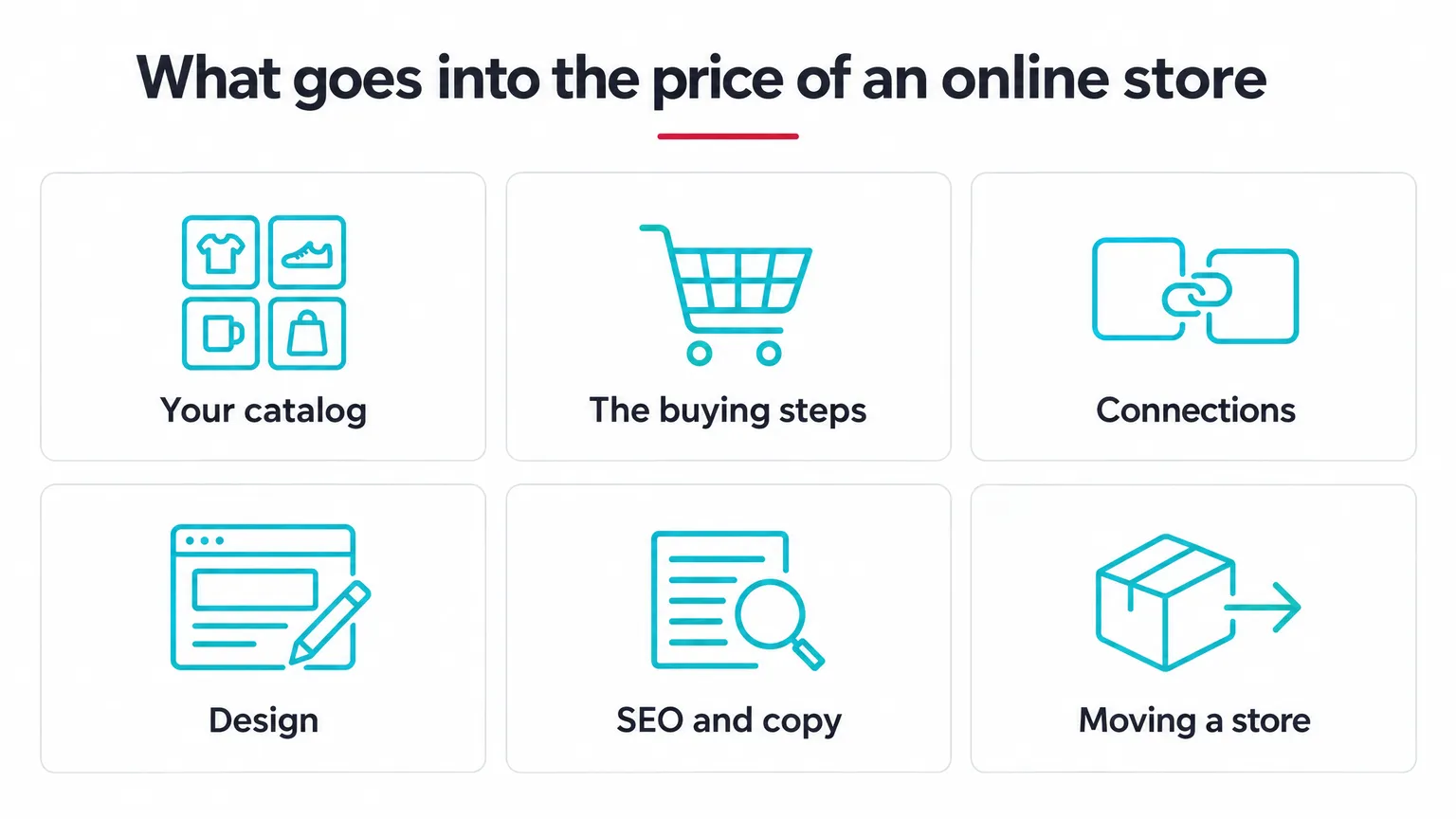
An online store’s price comes from six drivers. The catalog is how many products you sell and how many options each one carries, such as sizes, colors, bundles or subscriptions. The buying steps are everything a shopper does between finding a product and receiving it: search and filters, an account, the checkout and order tracking. Connections link the store to the tools behind it, such as stock, shipping and accounting, so nobody types an order in twice. Design can mean a ready-made theme adapted to your brand or a store designed around your products. Search research and written copy for every product and category bring shoppers to the store in the first place. A move from an existing store adds the transfer of products, customer accounts, past orders and old links. Each driver adds design, building and testing hours, and hours are what a quote prices. Page count matters far less: two stores with the same number of products can need very different builds, because shoppers do different things on them.
Your catalog and product options
A bigger catalog costs more, and options cost more than products. Clutch notes that ecommerce sites often have many pages to hold long product lists, and that the larger the site, the more it costs to build (Clutch, 2026).
Options are where the hours hide. A T-shirt in five sizes and four colors is twenty versions, each with its own stock count and sometimes its own photo. Bundles need rules for what goes together and how the price adds up. Subscriptions need billing dates, pauses and cancellations.
Before you ask for a quote, count your products and list the options each one has. That single sheet does more for an exact price than any description of the look you want.
The buying steps: accounts, checkout, order tracking
Every step between “add to cart” and “your order has shipped” is design, code and testing. Clutch lists what an ecommerce site should be able to do: accept orders, take payments, handle shipping and provide customer service (Clutch, 2026).
Accounts add their own work. Shoppers need to sign up, sign in, reset a password and see their past orders, and the store has to make sure one customer can never open another customer’s orders. Order tracking means every order carries a status that the shopper can check.
These steps decide whether a visit becomes a sale. In Baymard Institute’s study of why U.S. shoppers leave a cart, 18% of those who left for a reason other than browsing said the site wanted them to create an account, and 17% said the checkout was too long or complicated (Baymard Institute). A quote that treats the checkout as a standard part with no design time is leaving that out.
Connections to your stock, shipping and accounting tools
Each system the store talks to adds work, because orders and stock have to move in the exact form that system expects. Clutch notes that stores needing a customer relationship system, a content system or search often go custom, and that those projects take longer and cost more (Clutch, 2026).
Typical connections for a small store are a stock list, a shipping service for labels and rates, accounting software and an email list. A connection is worth paying for when your team types the same order into two places today. Name every tool you use when you ask for a quote, and ask whether the developer has checked each one.
Custom design or a template
A ready-made theme costs less up front because the layout already exists. You give up a store shaped around your products: your pages fit the theme’s boxes, and features the theme lacks usually arrive as add-ons.
A custom design starts from your products, your photos and the questions your customers ask before they buy. Clutch advises weighing design costs alongside development before you sign, and budgeting for user research and usability testing if the shopping experience matters to your business (Clutch, 2026). Our guide to what a website costs compares templates, builders and custom design in more detail.
SEO and copywriting for products and categories
A store needs words on every product and category page, and someone has to write them. Copy taken straight from a supplier is the same copy on every other store that sells the product, which gives Google little reason to show yours.
Search work at build time means researching the words shoppers use, naming categories to match, and writing page titles and product descriptions around them. For a large catalog this is real time, so ask who writes the copy and how many products it covers.
Moving an existing store: products, accounts, orders and old links
A move from an existing store adds the transfer of products, images, customer accounts and past orders, plus a plan for every old link. Each old product and category address should point to its new page with a permanent (301) redirect, so search results and saved links keep working.
Product pages are the links most likely to break, because their addresses often change between systems. Ask for the redirect list as part of the quote, and ask who checks it after launch. Our website cost guide explains how that list is built.
| Driver | What it adds | Question to ask |
|---|---|---|
| Catalog and options | Setup and testing for every product version, bundle and subscription | How many products and options does the quote cover, and who enters them? |
| Buying steps | Design and testing for accounts, checkout and order tracking | Which buying steps are included, and how will you test them on phones? |
| Connections | Building and testing each link to your stock, shipping and accounting tools | Have you checked every tool we use, and what happens if one changes? |
| Design | Hours to design pages around your products instead of a theme | Is the design made for our store, or adapted from a theme? |
| SEO and copy | Search research and writing for every product and category page | Who writes the product and category copy, and for how many products? |
| Moving a store | Transfer of products, accounts and orders, plus a redirect for every old link | Is the redirect list in the quote, and who checks it after launch? |
How much does it cost to make an ecommerce site?
An ecommerce site costs what its builder’s time costs, and you have three ways to buy that time: a builder plan you run yourself, a template set up by a freelancer, or a custom store built by a team. Clutch notes that ready-made platforms and template builders suit smaller businesses that need few features or only a few product pages, while stores that need more tend to go custom and cost more (Clutch, 2026).
The three ways differ less in the first invoice than in what you pay for over time and what you have to manage yourself.
| Way to build | What you pay for | What you manage yourself | Who owns what |
|---|---|---|---|
| A builder plan you run yourself | A monthly plan, the add-ons you need and payment fees | Setup, products, design choices, copy, search work and every update | Your products and content are yours; the store runs inside the builder's service |
| A template set up by a freelancer | The freelancer's hours, the theme, and the plan or hosting underneath | Changes after handover, add-ons, and finding help when the freelancer is busy | Depends on whose accounts hold the store and the domain; ask |
| A custom store built by a team | Research, design, the build, testing and launch, then hosting and support | Products, orders and customers, day to day | Set in your agreement; ask for the domain and accounts in your name |
The last column matters most if you ever want to leave. On a builder, leaving usually means rebuilding the store somewhere else. With a freelancer or a team, ownership depends on the agreement, so get it in writing before work starts.
What is the cheapest ecommerce website?
The cheapest ecommerce website is a builder’s starter plan that you set up and run yourself. You pay the monthly plan and the payment fees, and you put in the hours.
You give up time and fit. You choose the theme, enter every product, write every page, set up shipping and taxes, and add an app for each feature the plan lacks. The store looks like other stores on the same builder, and its limits become your limits.
For a small catalog and a simple way of selling, that can be the right choice. Our own websites page says it in one line: “You want the cheapest site you can find. A builder will cost less, and we will tell you so.” See custom websites for who we are a good fit for.
How much does a 10 page website cost?
Pages do not set a store’s price, so a page count says little about what a store will cost. One product template can show a thousand products, while one checkout page can hold most of the build’s hours.
For an information website, page count matters more. Our guide to what a website costs answers the 10 page question for that kind of site.
What an online store costs to run each month
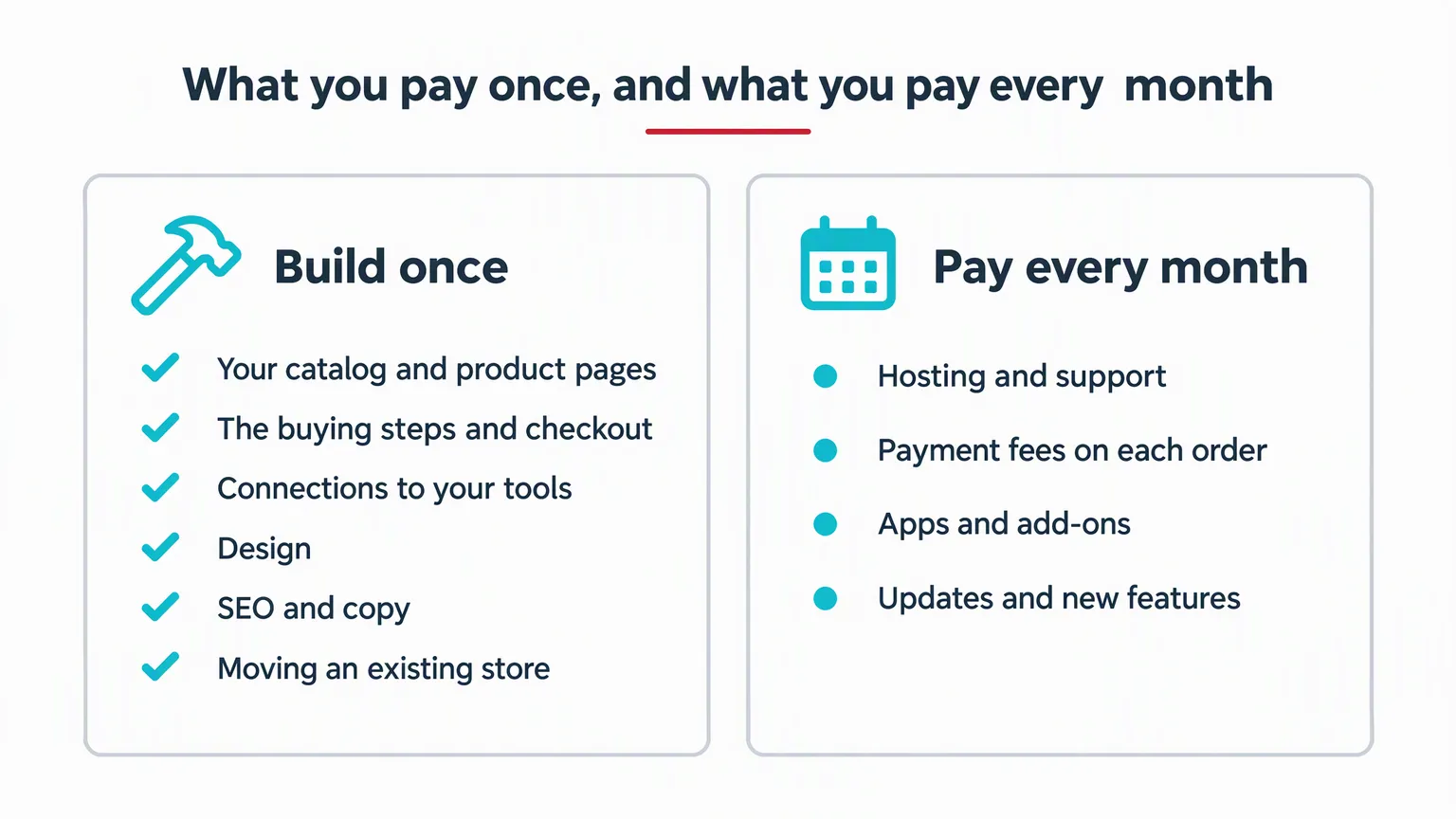
A store keeps costing money after launch, every month and on every order. The build is paid once; hosting, payment fees, add-ons and updates continue for as long as the store is open.
Hosting and support
Hosting is the service that keeps the store online, and support is the help you get when something breaks or needs changing. Clutch lists hosting among the services ecommerce developers provide, and lists secure hosting and a security certificate among the steps it recommends to keep a store and its customer data safe (Clutch, 2026).
Some developers fold hosting and support into one monthly fee; others bill them apart, or leave hosting to you. Ask what the monthly fee covers, how fast someone answers when checkout stops working, and who holds the hosting account.
What is an ecommerce fee?
An ecommerce fee usually means the payment processing fee: the share of each sale that the payment provider keeps. Stripe, for example, publishes a standard U.S. rate of 2.9% + 30 cents per successful transaction for domestic cards (Stripe).
At that rate, a $50 order costs $1.75 in card fees. The fee is charged on every sale, so it rises as the store sells more.
Rates differ between providers and between card types. Ask which payment provider the store will use, what it charges per order, and whether the platform adds a fee of its own.
Apps and add-ons
Apps add features a store does not have on its own, and each one can carry its own monthly bill. On a template store, it is common to find apps bolted on for every feature: reviews, upsells, countdown timers, wishlists.
Each app adds code to your pages, and several together can slow the store on a phone. Clutch notes that features such as chatbots, push notifications and abandoned cart retargeting often need plugins or custom development (Clutch, 2026). Before you add one, ask whether the feature can be part of the store instead of a monthly add-on.
Updates, new features and marketing
A store needs updates as browsers, payment providers and connected tools change. Plan for some update hours through the year, and ask whether they are in the monthly fee or billed when they happen.
New features come as your business grows: a new product type, a wholesale section, a gift card. Marketing is a separate cost again, since shoppers have to find the store before they can buy. Our team can run SEO, ads and social media for a store, and we discuss that ongoing work separately from the build.
Is ecommerce still worth it in 2026?
Online sales keep growing faster than retail as a whole, so the shoppers are there. The U.S. Census Bureau estimates that retail ecommerce sales, adjusted for seasonal variation, reached $340.2 billion in the second quarter of 2026, up 12.2 percent from the same quarter of 2025, while total retail sales rose 6.7 percent (U.S. Census Bureau). Ecommerce made up 17.1 percent of total retail sales in that quarter (U.S. Census Bureau).
That growth does not mean every store earns its cost. Whether yours does depends on your products, your margins and how shoppers find you, and no survey can answer that for your business.
The numbers do show where stores lose sales. Baymard Institute puts the average documented cart abandonment rate at 70.22%, calculated from 50 different studies (Baymard Institute). Some of those shoppers were only browsing, and some left because of the checkout itself. That second group is why the buying steps deserve a real share of any store budget.
A real example: what set the size of Mod&Tone
Mod&Tone, one of our latest projects, is an online store for tights, socks and gloves, and its size came from what shoppers do on it. Shoppers browse by category and size, buy with an account and track their orders, and the store has a wholesale section.
Browsing by size means every product carries size data, and the filters have to return only what is in stock in the size a shopper picked. Accounts mean sign-up, sign-in, order history and checks that one customer cannot see another’s orders. Order tracking means every order carries a status the shopper can look up. The wholesale section serves a second kind of buyer from the same store.
None of those four features is a page in the usual sense, and each one took design, code and testing. A store with the same number of products and none of those features would be a much smaller job.
One of our ecommerce clients, Sam Rosenberg, wrote in a Google review in May 2022 about an e-commerce website project: “They were very easy to work with and very responsive to any changes I wanted to make.” You can see Mod&Tone with our other projects on our Work page.
When the wholesale side grows into its own ordering system, the job changes kind. Bulktify, another of our latest projects, is an online ordering platform for wholesale businesses: retailers order through a self-service portal, the wholesaler manages everything from one dashboard, and it handles credit limits, net-30/60 terms, automatic invoices and payment reminders. It also syncs with the store platforms wholesalers already use. That is a web app, and it is priced like one; our guide to web app vs website explains the difference.
Questions to ask before you get an ecommerce quote
Seven questions show most of what a store quote includes and leaves out. Ask every developer the same seven, and the quotes become easy to compare.
- Is the price fixed or billed by the hour? An hourly estimate can grow with every change; a fixed price tells you the whole build cost first.
- What exactly is included? Ask whether product entry, product photos, copywriting and search work are in the price, and for how many products.
- Which payment provider will the store use, and what are its fees? Ask for the fee per order in writing, and whether the platform takes a share too.
- Who owns the domain and the store? Ask whose name is on the domain, the hosting and the store accounts, and what you take with you if you leave.
- How do old product links move to the new store? If you are moving an existing store, ask for the redirect list and who checks it.
- What does it cost each month after launch, and what does that include? Hosting, support, add-ons and updates: which are in the fee, and which are billed?
- Can I change pages and the blog myself? Ask how you will edit the words and pictures after launch, and what needs the developer.
Compare the answers before you compare the totals. Two quotes that answer these questions differently are pricing two different stores.
How we price an online store
We give one fixed quote for the whole store before any work starts. Your fixed quote is built from six things:
- your catalog
- the pages
- the buying steps
- product options, bundles or subscriptions
- connections to your systems
- a move from an existing store
It starts with a free call of about 15 minutes, where we learn about your products, your customers and what they keep asking before they buy. Then we research your customers and competitors and the words shoppers use to look for your products.
Next we plan the catalog, filters, product pages, customer accounts and checkout together. We design your homepage and, where the project needs one, a clickable demo of the key buying steps. Then you get one fixed quote and decide, with the design in front of you.
Nothing is built until you approve. We then code the agreed store and test browsing, accounts, orders and payments before launch. Each store we make is built to WCAG 2.2 AA (we do our best; no store can guarantee full accessibility), sets no tracking cookies without consent, has a clear privacy page and is checked so that one customer cannot open another customer’s orders.
If you later want something the quote did not cover, we price it before the work starts. The total never moves without your agreement.
Talk to us about your online store
Tell us what you sell and how your customers buy, and we will show you how we would plan a store around them. You can read more about our custom online stores built around how your customers buy.
How Much Does a Website Cost?
What a website costs depends on design, pages, features and who writes it. See what drives the price, real survey figures, and how to get a fixed quote.
Web App vs Website: Which Do You Need?
Website, web app or mobile app? What each one is, how they differ, and a few plain questions that tell you which one your business needs.